
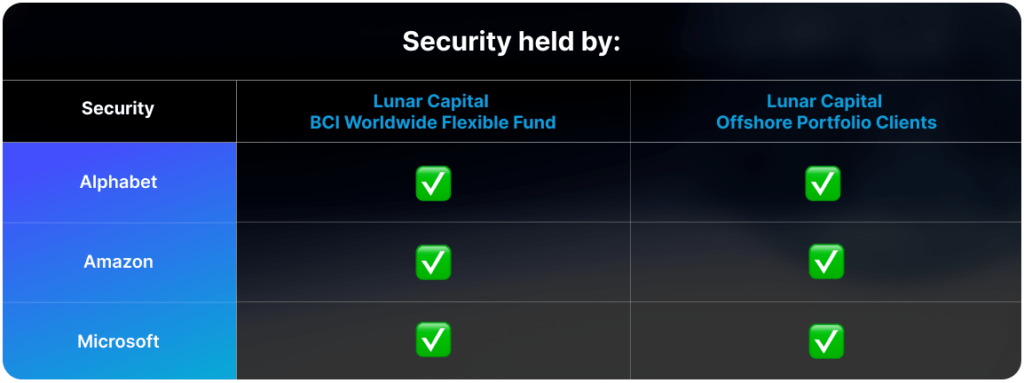
Over the last few years, the world’s largest technology companies have committed extraordinary sums to building datacentres, driven by the rapid expansion of cloud computing and progress in artificial intelligence. For a long time, this spending was largely ahead of the revenue. Recent results from Microsoft, Amazon, and Alphabet now suggest that this gap is starting to close, with benefits pointing to datacentre capacity finally translating into sales and productivity improvements as new facilities come online.
In its most recent quarter, Microsoft generated total revenue of $82.9 billion, of which $34.6 billion came from Microsoft’s Intelligent Cloud segment. Roughly 42% of Microsoft’s revenue is now tied directly to cloud services that run on its global network of datacentres. Within this, Microsoft disclosed that its AI business has reached an annualised revenue run rate of $37 billion, more than double the level of the prior year. Management has been clear that demand for these services continues to exceed available capacity, with shortages expected to persist into 2026.
As new datacentres are completed and connected to the grid, the AI-infrastructure companies are effectively able to turn that unmet demand into revenue.
Amazon’s experience through their cloud and AI business, Amazon Web Services, tells a similar story. In the latest quarter, AWS generated $37.6 billion in revenue, up 28% year over year. AWS accounts for roughly one-fifth of Amazon’s total sales, but 59% of Amazon’s operating profit. AWS reported a backlog of $325 billion in committed contracts, excluding a recent $100 billion deal with Anthropic.
Alphabet’s figures reinforce this same pattern. Total company revenue reached $109.9 billion in the quarter, with Google Cloud contributing $20 billion. Cloud revenue grew by 63%, driven largely by a sharp increase in demand for AI services, including an almost eight-fold rise in sales of Gemini Enterprise. While Alphabet’s cloud business is still quite smaller than its advertising business, its importance is rising quickly as the company continues to build out services and infrastructure for the age of AI.
For Microsoft, Amazon, and Alphabet, their AI infrastructure and services are translating into revenue and productivity gains. These services are not only in demand by their clients, but are also being used by internal teams to drive productivity growth across their own businesses.
These early signs of revenue growth do not mean the risks have disappeared. All three companies continue to invest heavily, and questions remain around long-term pricing, competition, and whether demand will be strong enough to absorb further capex. That said, the conversation has clearly shifted. The AI cloud companies’ investments are now beginning to show tangible returns, offering encouraging signals from the early stages of the datacentre build-out.
Click here to access your account to view statements, obtain tax certificates, add or make changes to your investments.
Our email address is: [email protected]
Disclosures
Lunar Capital (Pty) Ltd is a registered Financial Services Provider. FSP (46567)
Read our full Disclosure statement: https://lunarcapital.co.za/disclosures/
Our Privacy Notice: https://lunarcapital.co.za/privacy-policy/
The Lunar FR Worldwide Flexible Fund Fact Sheet can be read here.
This stocktake is prepared for the clients of Lunar Capital (Pty) Ltd. This stocktake does not constitute financial advice and is generated for information purposes only.