
Food Fight – Shoprite vs Woolworths

Author: Danyaal Munshi

Food Fight – Shoprite vs Woolworths

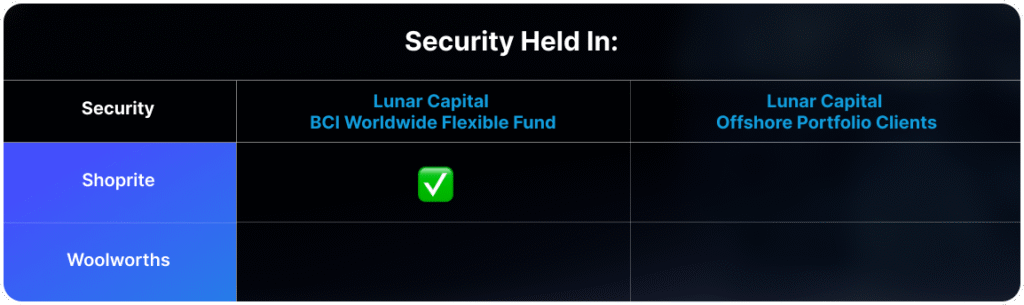
Last week, two South African grocery retailers, Shoprite and Woolworths, released their financial results for FY 2025, revealing contrasting performances. 

Shoprite reported revenue of R256 billion, up 8.6% year-over-year. Gross profit rose 10.6% to R61.4 billion, while operating income increased 16.6% to R15 billion. These results were buoyed by the exceptional growth of its Sixty60 delivery service, which generated R18.9 billion in revenue — up 48% year-over-year. Sixty60 now accounts for 8.9% of total group sales and 19% of Checkers sales. CEO Pieter Engelbrecht noted that Sixty60 customers are nearly four times more valuable than in-store-only customers, with higher average order values. 

Shoprite also demonstrated strong cost management. Internal inflation was kept below 2%, and operating expenses rose 7.4%, a slower pace than revenue growth. Notably, diesel costs fell 56% to R355 million, and repairs and maintenance expenses declined 7.8%, contributing to margin expansion. 

Woolworths, by contrast, posted more subdued results. Revenue grew 3.8% to R80.2 billion, but gross profit declined 0.7% to R27.3 billion, and operating income fell 15.6% to R5.1 billion. While the Food division performed well, generating R51.2 billion, up 8.7%, the Fashion, Beauty, and Home (FBH) and Country Road Group (CRG) divisions weighed down overall performance. FBH grew 2.4% to R15.1 billion, while CRG declined 10.5% to R12.4 billion. These segments typically carry higher operating margins, so their underperformance had a disproportionate impact on profitability. 

Shoprite and Woolworths’ results highlight the diverging fortunes of two major retailers; one benefiting from scale and innovation, the other weighed down by underperforming segments. But for both, the path forward remains challenging. South Africa’s weak macroeconomic backdrop, marked by low growth and constrained consumers, continues to limit the upside for even the best-run businesses.
Security
Key indicators

Click here to access your account to view statements, obtain tax certificates, add or make changes to your investments.

Our email address is: [email protected]

Disclosures
Lunar Capital (Pty) Ltd is a registered Financial Services Provider. FSP (46567)
Read our full Disclosure statement: https://lunarcapital.co.za/disclosures/
Our Privacy Notice: https://lunarcapital.co.za/privacy-policy/
The Lunar BCI Worldwide Flexible Fund Fact Sheet  can be read here.
This stocktake is prepared for the clients of Lunar Capital (Pty) Ltd. This stocktake does not constitute financial advice and is generated for information purposes only.


Share article

Latest Posts

What does the SpaceX IPO say about the broader market.
SpaceX-cluded
What does the SpaceX IPO say about the broader market
CrowdStrike’s latest quarterly results reflect a business that continues to scale at an impressive rate, while also illustrating some of the tensions between growth, profitability, and valuation that increasingly define the cybersecurity sector. The company reported total quarterly revenue of $1.39 billion, up 26% year-on-year, reinforcing its position as one of the fastest-growing large-cap cybersecurity platforms. Growth was supported by strong demand across its Falcon platform, with net new annual recurring revenue (ARR) of $256 million, up 32%. This brought total ending ARR to $5.51 billion, a 24% increase, highlighting the durability of its subscription-based model and the continued expansion of its installed base. Despite this top-line momentum, profitability remains work in progress. CrowdStrike reported a GAAP operating loss of $30.6 million, a meaningful improvement from the $108.7 million loss recorded in the prior period, but still indicative of a business investing heavily in growth. While the trajectory is clearly improving, the pace of margin expansion remains a key area of focus for investors, particularly as the business scales. A central theme in management’s commentary was the growing intersection between artificial intelligence and cybersecurity. The company pointed to what it described as an inflection point, where AI is not only enhancing defensive capabilities but is increasingly being weaponised by attackers. The proliferation of AI-driven threats raises the complexity and frequency of cyberattacks, reinforcing the need for advanced, real-time protection. In this context, CrowdStrike’s access to leading AI models through partnerships with firms such as OpenAI and Anthropic stands out as an important competitive advantage. These relationships, alongside collaborations with Microsoft and IBM, position CrowdStrike at the centre of an evolving ecosystem where cybersecurity, cloud infrastructure, and AI capabilities are becoming deeply interconnected. Stock-based compensation still remains elevated and continues to weigh on the company’s path to sustained profitability. While common across high-growth technology businesses, it represents a real economic cost to shareholders and, at current levels, raises questions about long-term margin structure. Valuation is another important consideration. CrowdStrike continues to trade at a premium relative to its revenue base, reflecting both its growth profile and its perceived strategic importance in the cybersecurity landscape. However, this also leaves less room for execution missteps. Notably, while revenues grew by 26%, this fell short of some market expectations, suggesting that the bar remains high and that incremental disappointments can have an outsized impact on sentiment.
Crowding out the Competition
Cybersecurity for the AI era
How do you compare Walmart to Amazon
Brick and E-commerce
How do you compare Walmart to Amazon

Lunar Capital
on Eastwave Radio

Every Wednesday, at 07h45, Sabir chats with Nazia from Eastwave Radio (92.2 fm, live stream on
www.eastwave.co.za) on investing and the markets.

eastwave-radio