
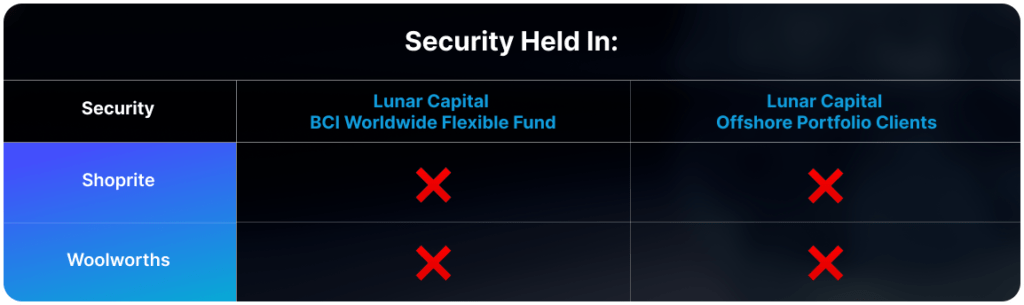
The latest interim results from Woolworths and Shoprite highlight two distinct approaches to growth in a consumer environment that remains under pressure.
Woolworths delivered first half revenue of R42.5 billion, up 5.4% year-on-year, but profitability fell sharply, with net income down 33%. Food continues to anchor the business, contributing roughly two thirds of group’s revenue, yet margin pressure has intensified. Internal food inflation was higher during the period as foot- and-mouth disease pushed meat prices up sharply, by around 30%. Food gross margin slipped to 24.8%. Woolworths’ increased promotions in Australia caused a modest drop in Food gross margin.
A similar dynamic played out in Fashion, Beauty and Home. Gross margin declined to 45.8% as management stepped up discounting to clear excess inventory in the broader business. Separately, the price reductions in children’s apparel were strategic, aimed at strengthening value and driving volume. Children’s clothing volumes rose by roughly 30% year-on-year. The trade-off was a negative impact on the gross margin outcome for the FBH division. At the same time, ongoing investment in the Midrand food distribution centre weighed on profitability. Collectively, these decisions point to a business focused on restoring operational discipline, improving inventory turnover, and positioning itself for more sustainable earnings once consumer pressure eases.
Shoprite’s results tell a contrasting story built on scale, efficiency, and execution. Group revenue rose 7.2% to R137 billion, while trading profit increased to R7 billion, sustaining a trading margin of 5.7%. Years of investment in data analytics, artificial intelligence, and price optimisation are now paying off, enabling the group to keep internal food inflation to just 0.7% and still run promotional activity without sacrificing margins.
Growth has been driven by both expansion and diversification. Shoprite opened over 260 new stores during the period, with a strong bias toward lower LSM formats, while adjacent businesses such as pet care and baby products continued to scale. Digital momentum remains a key differentiator: Checkers Sixty60 grew revenue by more than 30% to R11.9 billion, reinforcing the group’s convenience led value proposition. Shoprite noted that capital expenditure is starting to ease. During the period, capex dropped to below 3% of sales. This indicates a shift from rapid expansion to a focus on optimising its existing assets.
Both strategies carry risks. Woolworths remains exposed to food inflation and discretionary spending weakness, while Shoprite’s scale driven model raises questions about saturation and long-term growth sustainability. Yet both businesses appear strategically consistent. In an uncertain macroeconomic environment, their results underscore the trade-off between protecting margins today and investing for growth tomorrow.
Click here to access your account to view statements, obtain tax certificates, add or make changes to your investments.
Our email address is: [email protected]
Disclosures
Lunar Capital (Pty) Ltd is a registered Financial Services Provider. FSP (46567)
Read our full Disclosure statement: https://lunarcapital.co.za/disclosures/
Our Privacy Notice: https://lunarcapital.co.za/privacy-policy/
The Lunar FR Worldwide Flexible Fund Fact Sheet can be read here.
This stocktake is prepared for the clients of Lunar Capital (Pty) Ltd. This stocktake does not constitute financial advice and is generated for information purposes only.