
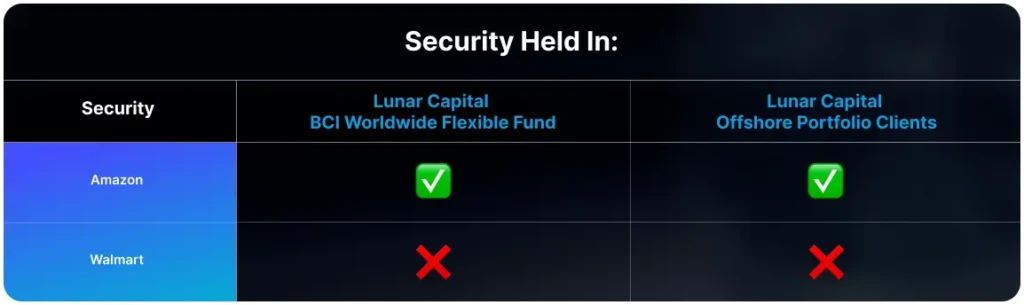
Despite sharing an almost identical revenue base of nearly three-quarters of a trillion dollars, Amazon commands triple the market value of Walmart. However, Walmart trades at a richer earnings-multiple (40x) than Amazon (31x), despite Amazon growing both its top and bottom lines at a significantly faster rate.
Walmart: Courting high income earners
Historically, Walmart’s core proposition has been “Everyday Low Prices,”, It relied on its massive physical presence and scale to weather economic shocks. However, sticky inflation in the US has shifted consumer dynamics. Higher-income shoppers, looking to stretch their dollars, have increasingly turned to Walmart. Walmart is capturing this demographic by aggressively expanding its e-commerce capabilities. This shift is important for two reasons:
The Basket Mix: Higher-income earners typically buy higher-margin general merchandise rather than just the low-margin groceries and tend to have larger ‘basket’ sizes.
Operating Leverage: Market expectations are betting that Walmart can grow its operating income at a faster rate than revenue, driven by the slightly more lucrative fulfilment and digital services tied to its scaling e-commerce platform.
Amazon: The Retail Beast Powered by Cloud and Ad Engines
Amazon’s retail operation is essentially a massive customer-acquisition funnel for its real profit drivers: cloud computing and digital advertising.
AWS Powerhouse: Amazon Web Services (AWS) generates just 18% of group revenue but accounts for a massive 56% of operating income. To maintain its dominance amidst the explosive demand for AI, Amazon is targeting a staggering $200 billion in capital expenditure this year, with the majority earmarked for cloud infrastructure.
The High-Margin Ad Machine: Over the last 12 months, Amazon’s advertising division brought in $72 billion. Unlike social media platforms where users browse casually, shoppers on Amazon display high “purchase intent.” Advertisers willingly pay a premium for this intent, fuelling a massive, high-margin revenue stream that has also helped increase Amazon’s corporate operating margins from 2.5% to 11.5% in three years.
The Bottom Line: Does the Valuation Make Sense?
Both businesses are highly sensitive to inflation and other shocks, but they fight it with different arsenals. Walmart uses its unmatched brick-and-mortar scale to absorb price shocks, though its operating income remains vulnerable. Amazon, by contrast, boasts a much more diversified business toolkit, offsetting retail pressures with high-margin software, cloud, and advertising ecosystems. The question remains: over the next few years, will Walmart be able to grow their earnings at a fast enough rate to justify the PE multiple?
Click here to access your account to view statements, obtain tax certificates, add or make changes to your investments.
Our email address is: [email protected]
Disclosures
Lunar Capital (Pty) Ltd is a registered Financial Services Provider. FSP (46567)
Read our full Disclosure statement: https://lunarcapital.co.za/disclosures/
Our Privacy Notice: https://lunarcapital.co.za/privacy-policy/
The Lunar FR Worldwide Flexible Fund Fact Sheet can be read here.
This stocktake is prepared for the clients of Lunar Capital (Pty) Ltd. This stocktake does not constitute financial advice and is generated for information purposes only.