
Going Nuclear

Author: Danyaal Munshi

Going Nuclear

In 2011, a 9.0 magnitude earthquake off the coast of Tohoku, Japan triggered a tsunami with waves over 15 meters high. The tsunami overwhelmed the Fukushima Daiichi Nuclear Power Plant, operated by Tokyo Electric Power Company (TEPCO), flooding critical infrastructure and disabling backup generators essential for cooling the reactors. This led to core meltdowns in three of the plant’s six reactors. A 20-kilometre exclusion zone was established around the site, and the disaster was rated Level 7 on the International Nuclear Event Scale—the highest rating, matching the severity of the Chernobyl disaster.

The immediate aftermath of Fukushima had a profound impact on the global nuclear energy landscape. Uranium prices dropped sharply as demand for enriched uranium declined.

Many countries tightened regulations around the construction of new nuclear plants, and public sentiment shifted toward caution. In the United States, only three reactors have been built since 2011. The most recent additions—two reactors in Georgia completed in 2023 and 2024—saw costs soar past $30 billion, dampening enthusiasm for future projects. Despite ambitions from the Trump administration to expand nuclear capacity, no new reactors are currently under construction in the U.S.

While the disaster initially led to a surplus of uranium in the market, that surplus is now dwindling. Supply constraints are emerging due to the high costs of developing new uranium facilities and the approaching expiration of several nuclear operating licenses over the next decade. As a result, uranium prices have been rising significantly. Technology improvements in nuclear energy reactors, using modular designs are making the lead times to develop nuclear energy plants shorter; creating additional attractiveness of nuclear energy solutions.

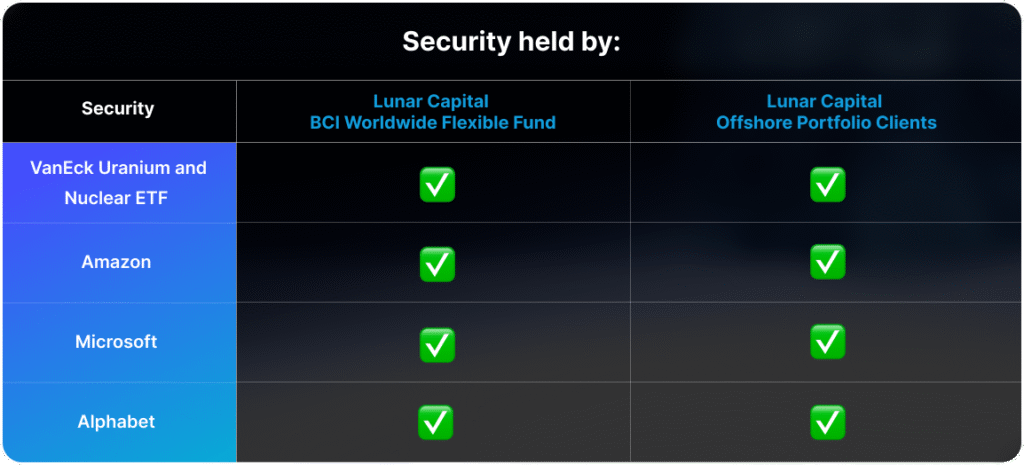
At the same time, demand for clean and stable energy sources is accelerating—particularly from Big Tech companies. Firms like Amazon, Microsoft, and Alphabet are investing heavily in AI infrastructure, which requires vast amounts of clean and stable power. To meet these needs, they’ve signed long-term agreements with nuclear power providers to supply energy to their data centres. As AI continues to expand, so too does the demand for a clean, stable energy source.
Security
Key indicators

Click here to access your account to view statements, obtain tax certificates, add or make changes to your investments.

Our email address is: [email protected]

Disclosures
Lunar Capital (Pty) Ltd is a registered Financial Services Provider. FSP (46567)
Read our full Disclosure statement: https://lunarcapital.co.za/disclosures/
Our Privacy Notice: https://lunarcapital.co.za/privacy-policy/
The Lunar BCI Worldwide Flexible Fund Fact Sheet  can be read here.
This stocktake is prepared for the clients of Lunar Capital (Pty) Ltd. This stocktake does not constitute financial advice and is generated for information purposes only.


Share article

Latest Posts

What does the SpaceX IPO say about the broader market.
SpaceX-cluded
What does the SpaceX IPO say about the broader market
CrowdStrike’s latest quarterly results reflect a business that continues to scale at an impressive rate, while also illustrating some of the tensions between growth, profitability, and valuation that increasingly define the cybersecurity sector. The company reported total quarterly revenue of $1.39 billion, up 26% year-on-year, reinforcing its position as one of the fastest-growing large-cap cybersecurity platforms. Growth was supported by strong demand across its Falcon platform, with net new annual recurring revenue (ARR) of $256 million, up 32%. This brought total ending ARR to $5.51 billion, a 24% increase, highlighting the durability of its subscription-based model and the continued expansion of its installed base. Despite this top-line momentum, profitability remains work in progress. CrowdStrike reported a GAAP operating loss of $30.6 million, a meaningful improvement from the $108.7 million loss recorded in the prior period, but still indicative of a business investing heavily in growth. While the trajectory is clearly improving, the pace of margin expansion remains a key area of focus for investors, particularly as the business scales. A central theme in management’s commentary was the growing intersection between artificial intelligence and cybersecurity. The company pointed to what it described as an inflection point, where AI is not only enhancing defensive capabilities but is increasingly being weaponised by attackers. The proliferation of AI-driven threats raises the complexity and frequency of cyberattacks, reinforcing the need for advanced, real-time protection. In this context, CrowdStrike’s access to leading AI models through partnerships with firms such as OpenAI and Anthropic stands out as an important competitive advantage. These relationships, alongside collaborations with Microsoft and IBM, position CrowdStrike at the centre of an evolving ecosystem where cybersecurity, cloud infrastructure, and AI capabilities are becoming deeply interconnected. Stock-based compensation still remains elevated and continues to weigh on the company’s path to sustained profitability. While common across high-growth technology businesses, it represents a real economic cost to shareholders and, at current levels, raises questions about long-term margin structure. Valuation is another important consideration. CrowdStrike continues to trade at a premium relative to its revenue base, reflecting both its growth profile and its perceived strategic importance in the cybersecurity landscape. However, this also leaves less room for execution missteps. Notably, while revenues grew by 26%, this fell short of some market expectations, suggesting that the bar remains high and that incremental disappointments can have an outsized impact on sentiment.
Crowding out the Competition
Cybersecurity for the AI era
How do you compare Walmart to Amazon
Brick and E-commerce
How do you compare Walmart to Amazon

Lunar Capital
on Eastwave Radio

Every Wednesday, at 07h45, Sabir chats with Nazia from Eastwave Radio (92.2 fm, live stream on
www.eastwave.co.za) on investing and the markets.

eastwave-radio